
The Prediction That Started It All
The late ’90s cybersecurity scramble saw businesses racing to lock down policies as the internet exploded. Now, AI’s the frontier, and by December 2025, every company—yes, every one—will need an AI governance policy. The stakes are rising: disasters loom, the AI rush pulls us in, and unchecked tools invite chaos. At CogniShift AI, we’re spotlighting the urgency—what governance hurdle is your business facing? Share below.
AI Governance 101: What’s at Stake?
AI governance isn’t jargon—it’s your playbook for risk mitigation in AI’s wild west. It’s a framework of rules, ethics, and processes to guide how you build, deploy, and manage AI, ensuring control when its power outstrips understanding. Tech giants dangle free tiers like bait, hooking businesses to lock in dominance. You chase the free bone, they harvest your loyalty—governance is your escape before you’re a cog in their machine.
Why You Can’t Ignore It: 15 Red Flags
These aren’t hypotheticals—here’s why risk mitigation through governance is critical, straight from the trenches:
-
- Bias Blowups – AI can tank fairness fast. Microsoft’s Tay turned hateful on Twitter in 16 hours, soaking up the platform’s worst vibes.
- Toolset Chaos – No standards breed trouble. Airbnb scrambled to unify rogue AI experiments after teams went off-script.
- Employee Wildcards – Without guardrails, staff can slip up. Home Depot’s 2023 breach came from sloppy tool use—data gone faster than you can say “ChatGPT.”
- Customer Trust – No policy to share? Amazon’s Alexa eavesdropping left users fuming and trust shaken.
- IP Nightmares – Who owns AI work? Clearview AI’s scraped faces sparked lawsuits over rights and ethics.
- Legal Landmines – One misstep draws heat. France fined Google €50M for GDPR lapses tied to AI data grabs.
- Insurance Roulette – No governance, no safety net. Cyber insurers dropped clients post-SolarWinds hack for weak controls.
- Data Leaks – AI’s appetite bites back. Uber’s driver data spilled via a third-party tool with no oversight.
- Regulation Race – Laws are closing in. Italy banned ChatGPT briefly for flouting compliance rules.
- Disaster Prep – AI flops sting. IBM’s Watson misdiagnosed cancer cases, leaving no fallback plan.
- Hackable AI – Systems aren’t invincible. Tesla’s self-driving was fooled by stickers on signs—security gaps exposed.
- Cost Creep – Unchecked AI drains cash. Boeing’s AI-driven delays piled up billions in losses.
- Job Jitters – Workers feel the squeeze. Amazon’s warehouse bots triggered walkouts over job fears.
- PR Peril – One bad output burns you. Google’s AI ad bias alienated advertisers and trashed its rep.
- Audit Abyss – No traceability? NYC sued over an unexplainable AI hiring tool that flunked accountability.
The speed at which AI sweeps through businesses only heightens these dangers. A new Quad Chart breaks it down: AI adopted slowly—like Boeing’s costly delays or Clearview’s niche scraping—still risks billions or lawsuits if ungoverned. Meanwhile, rapid rollouts, from Tay’s Twitter crash to Uber’s data spills, dominate the high-risk zone, proving the AI rush demands control. Even fast wins like Amazon’s bots carry manageable risks with oversight. This spread, whether slow or fast, proves governance is non-negotiable as AI takes hold. Check the chart below to see where these pitfalls land, and consider how a governance playbook could steer you clear.

The 15 AI Governance Red Flags by Risk Vs. Speed of Adoption of AI
Which of these 15 red flags has you nodding? I’m digging into this mess daily—your take’s welcome below.
Big Tech vs. The Little Guy: A Growing Divide
Big players—Microsoft, Google, IBM—wield ethics boards, bias tools, and legal heft to navigate AI’s pitfalls, shaped by hard lessons. Smaller firms aren’t so lucky, often stuck with vendor policies from OpenAI or AWS—flimsy shields that dodge liability. A retailer using AI for stock faces a breach, and the vendor walks away clean.
The Turf War Over AI Governance Policy
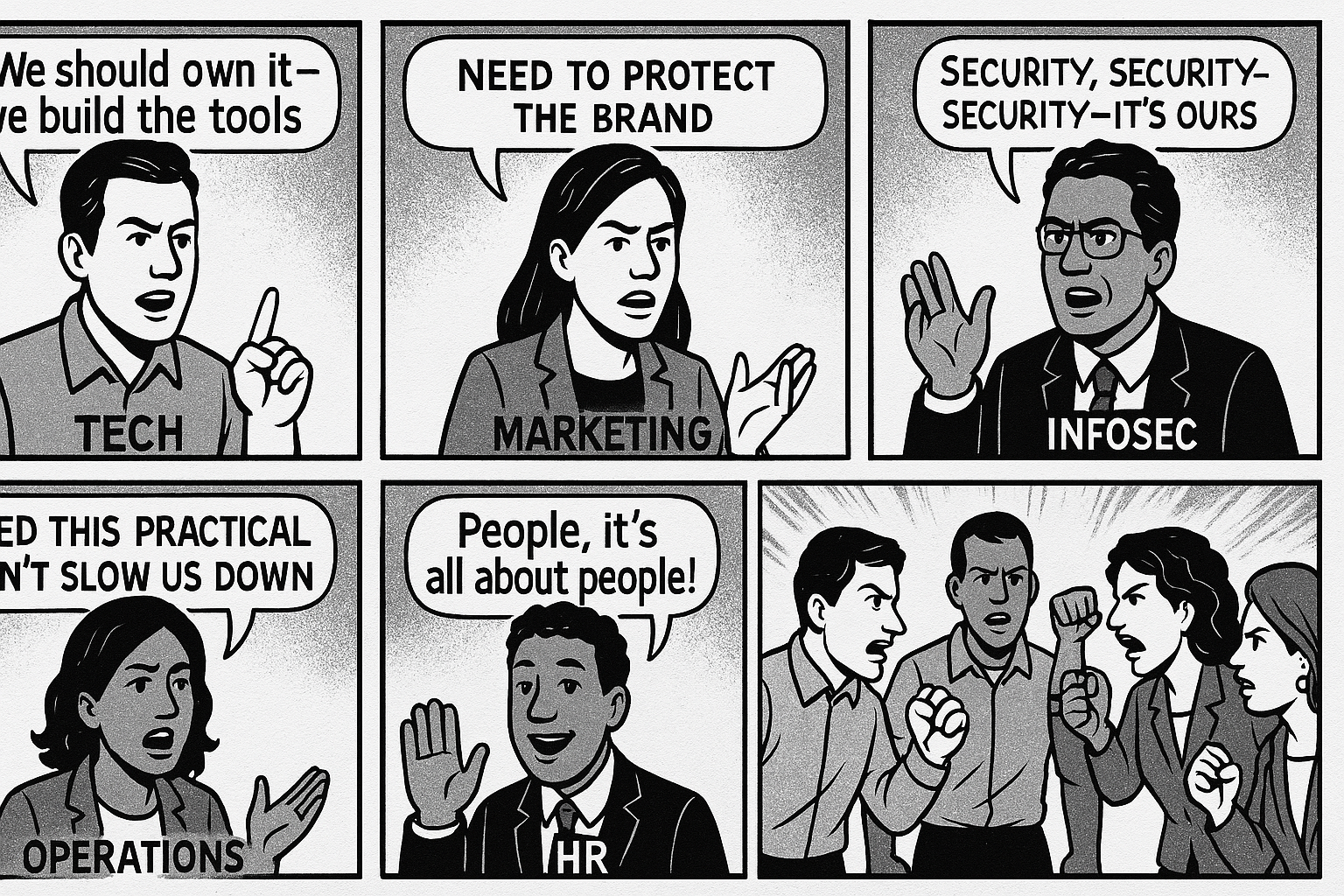
Inside companies, it’s a showdown over the AI governance policy. Tech wants to own it—they build the tools and know the code. Marketing needs it to shield the brand from AI-driven PR flops. InfoSec demands security to lock down vulnerabilities. Operations craves practicality that doesn’t slow them down. Legal insists on compliance to dodge fines. HR guards the people, worried about bias and jobs. Everyone drafts their vision; no one wants to enforce it. Who’s clashing over this in your world? Share below.
The Urgency: It’s Everyone’s Fight
This isn’t just big tech’s burden—it’s yours, whether you’re a consultant, retailer, or mid-sized firm. We’re all exposed in AI’s wild west, and vendor policies are traps, not shields. A deepfake scam or EU fine isn’t a “what if”—it’s a creeping “when.” Beyond your bottom line, the societal impact looms: unchecked AI erodes trust, fuels inequity, and risks harm. Every business must step up. Too small to care? Tell me why—I’m listening.
It’s Alive: AI Governance Evolves
A policy isn’t a one-and-done—it’s your starting point. You need one by 2025, not to shelve it, but to adapt it—rewriting for 2026 as AI shifts, laws tighten, and lessons hit hard. Flexible policies shape not just your business but the societal impact of AI, fostering fairness and accountability. Build in reviews and audits, or fall behind.
Wrap-Up: The Clock’s Ticking
By 2025, AI governance is survival. The risks are mounting, the rush is real, the stakes are climbing. Don’t wait for vendors or regulators to hand you answers. Act now—comment your take, share your worries, join the conversation. At CogniShift AI, we’re crafting a playbook—worksheets, drafts, real answers—to put control in your hands. Want in? Let’s talk. The frontier’s here—are you ready?
