
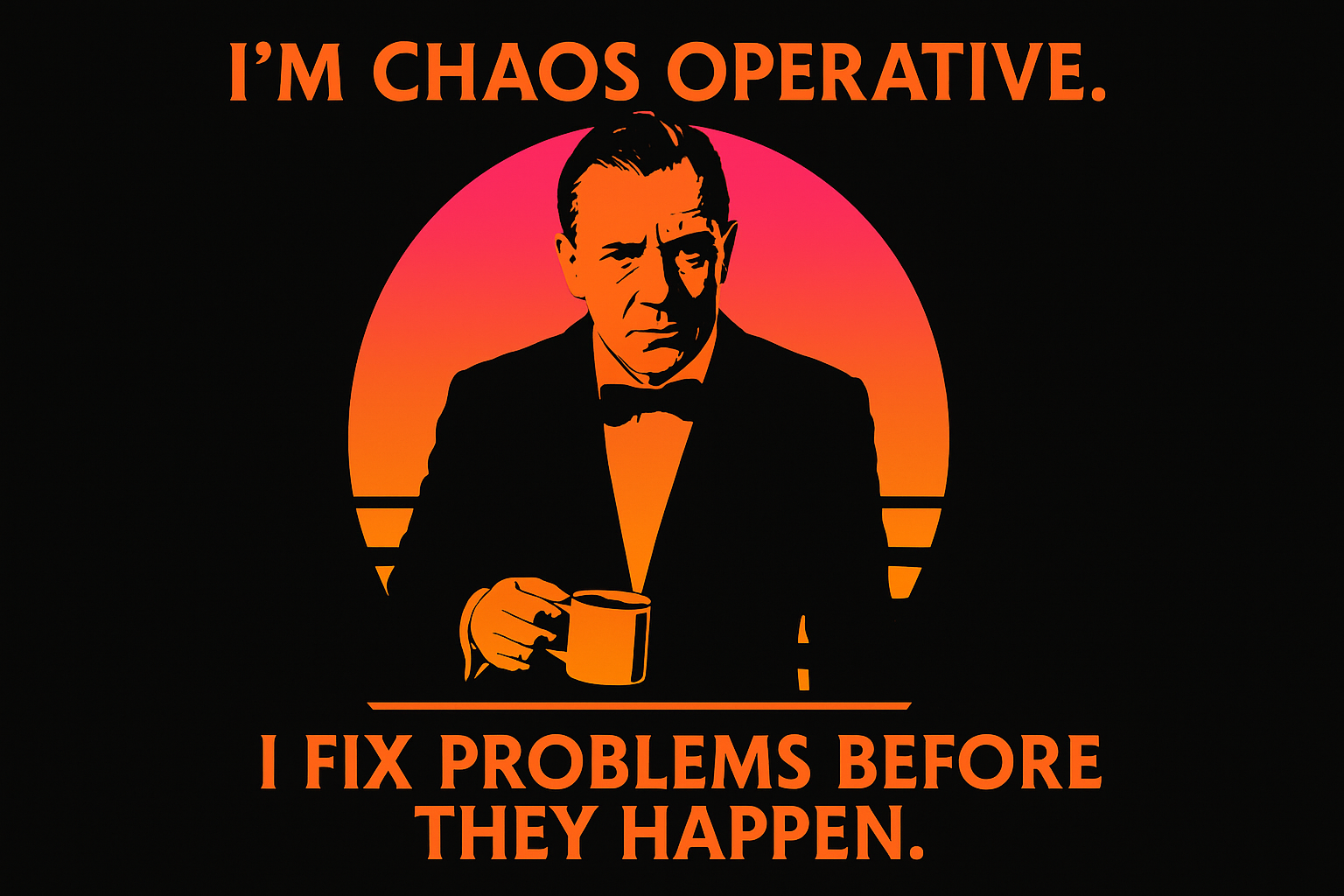
Your tech company’s a rocket, fueled by visionaries, dreamers like founders, product gurus, or Elon-esque trailblazers conjuring the next big thing. They paint bold futures, rallying engineers and execs to chase unicorns on a chessboard market. But one wrong move, a glitch, a system crash, a vendor API choke, and their vision crashes. Enter the Chaos Operative, the shadow agent who reads the enemy’s playbook, shields the dream, and raises the bar before the shit hits the fan. Visionaries spark the fire; Chaos Operatives keep it from burning the house down. This isn’t a perk; it’s your tech org’s pulse, from scrappy startup to Silicon Valley titan. Strap in, this is a spy thriller where foresight’s the weapon, and failure’s off the table.
The Art of Seeing the Unseen
Tech’s a minefield, with risks cloaked in optimism and deadlines. Your team’s buried in the grind, sprints, standups, KPIs. They’re so wedded to the visionary’s code that confirmation bias purrs, “This is gold,” escalation of commitment growls, “No turning back,” and groupthink silences the lone dev waving a red flag. Enter the Chaos Operative, the rogue agent with night-vision goggles, spotting disasters, user backlash, outages, compliance traps, before they blow. Think Ethan Hunt, swapping bombs for PR meltdowns and system crashes.
Companies already run operatives undercover. Google’s red team caught Glass’s privacy holes, dodging a PR inferno. Microsoft’s Azure crew patched a 2020 exploit before hackers struck, saving trust. P&G’s risk squad foresaw kids munching Tide Pods and rolled out child-proof packaging, averting a safety nightmare. When chaos hit, Amazon’s incident commanders tamed a 2023 AWS outage that threatened Prime Day traffic, and Delta’s crisis team wrestled a $150M power failure. These operatives didn’t just mop up; they predicted and prevented, making “almost apocalypses” vanish.
When the Shit Hits the Fan (And It Will)
We’ve all watched a project skid into the ditch, muttering, “How’d we miss this?” A feature ships with bugs that tank retention. A vendor integration buckles. A system outage kills revenue. These aren’t just Theranos-level $700M frauds; they’re everyday traps gutting any org. The grind fuels blind spots, with initiative owners too deep in the visionary’s dream to see icebergs. Without a Chaos Operative, you’re not building; you’re gambling your future on a coin flip.
Why Every Tech Org Needs One, Yes, Even You
Ever shipped a feature that flopped because the UX screamed “tested by robots”? Or seen eng and marketing clash, leaving sales with a product nobody wants? Maybe your database buckled under load, tanking your app at Black Friday traffic. How about a misconfigured cloud exposing data because “it passed the dev checklist”? Or a GDPR slip inviting fines? These gremlins stalk every tech org, startup to FAANG. We’ve all had that “if only we’d seen it” moment, kicking ourselves post-crash, wishing we’d acted sooner.
- Design Flaws: A monolithic architecture chokes scaling, stalling growth. A Chaos Operative runs pre-mortems to catch design flaws, like Twitter’s early pivot from Ruby on Rails bottlenecks.
- Cross-Functional Chaos: Eng ships what marketing didn’t vet, or product overpromises. A Chaos Operative syncs silos, as Lockheed’s wargamers aligned F-35 supply chains.
- Biased UX: A customer experience ignoring accessibility flops with users. A Chaos Operative stress-tests UX, like P&G’s kid-proof Tide Pods packaging.
- Race Conditions: A vendor API chokes under load. A Chaos Operative simulates traffic, as Microsoft’s stress-tests did for Azure.
- Compliance Gaps: A fintech misses a regulatory check, risking fines like Monzo’s 2021 AML hit. A Chaos Operative audits, as Revolut did to stay clean.
These pitfalls don’t care about size. Startups die from one bad sprint; giants bleed billions (JPMorgan’s $175M Frank scam, anyone?). Maturity? Amazon’s SREs still scramble. Agile? Speed amplifies errors, like Uber’s 2017 data cover-up. Think owners can handle it? Laughable. Devs and PMs, neck-deep in JIRA, are too biased, like Kodak missing digital cameras they built. A Chaos Operative turns regret into action, predicting and shielding before the hit.
The Chaos Operative: Your Secret Weapon
This operative isn’t a reactive fixer, diving in post-boom like Winston Wolfe in Pulp Fiction. They’re proactive, reading the board like a chess master, guarding with sniper precision. Their arsenal:
- Technical Mastery: Risk frameworks (FMEA, Monte Carlo) and hacker flair shred threats, like P&G’s Tide Pods risk squad outsmarting safety traps.
- Strategic Vision: They align with the org’s dream, crafting long-term plays, like Google’s red team steering Glass from PR doom.
- Operational Grit: Streamlining processes, they ensure resilience, like Delta’s 2016 outage team keeping systems steady.
- Market Intelligence: Spotting trends and rival moves, they keep you ahead, like Spotify’s data dives dodging streaming wars.
- Outspoken Candor: Calling a spade a spade without starting wars, they expose risks, like Netflix’s candid fixes for streaming glitches.
- Cross-Functional Command: Syncing silos and managing vendors, they lead like Lockheed’s F-35 wargamers or Revolut’s API partners staying tight.
They spot risks (pre-mortems), decode complexity (pattern recognition), call flaws (candor), craft fixes (analytics), and pivot fast (decisiveness). They don’t just save your skin; they rewrite the game.
Why It’s Not Overkill, It’s Survival
Overkill? Tell that to burned budgets and ghosted users. Deloitte’s 2023 data says proactive risk roles cut losses by 20-30%. Walmart’s $10,000 tariff planning saved millions. Google’s Glass audits dodged a PR apocalypse. A Chaos Operative, hat-wearer in a startup, solo in a mid-sized shop, or team in a titan, pays off faster than a viral TikTok. We’ve all had that “what if” moment, watching a feature flop, wishing we’d caught it. The Chaos Operative makes “what if” your edge, not regret.
How to Deploy Your Operative
- Startups (5-50): CTO or PM wears the hat, running $1,000 pre-mortems on Trello. Notion’s check-ins caught UI bugs pre-launch. Cost: pocket change.
- Mid-Sized (50-500): Part-time solo Operative ($50,000/year) or trained PM ($5,000 workshop). Revolut’s compliance lead dodged Monzo’s fines. Cost: coffee run.
- Giants (500+): 3-5 person team ($500,000/year), like Microsoft’s red teams saving Azure. Cost: chump change vs. $4.45M breaches (IBM Security 2023).
- Integrate: Join sprints, report to CTOs, track risks in JIRA. Atlassian’s playbook nails it.
- Culture: Reward dissent like Netflix. Make skepticism sexy.
The Mission Is Live
In this tech thriller, the Chaos Operative is your Ethan Hunt, calling the enemy’s shots, guarding your empire, raising the stakes. Without them, your visionary dreams are dice rolls. Visionaries light the spark; Chaos Operatives keep the rocket from crashing. Every tech org, from basement coders to tech royalty, needs one. Hire one, train one, be one. The clock’s ticking, your move. Make it count, your empire’s watching.
