
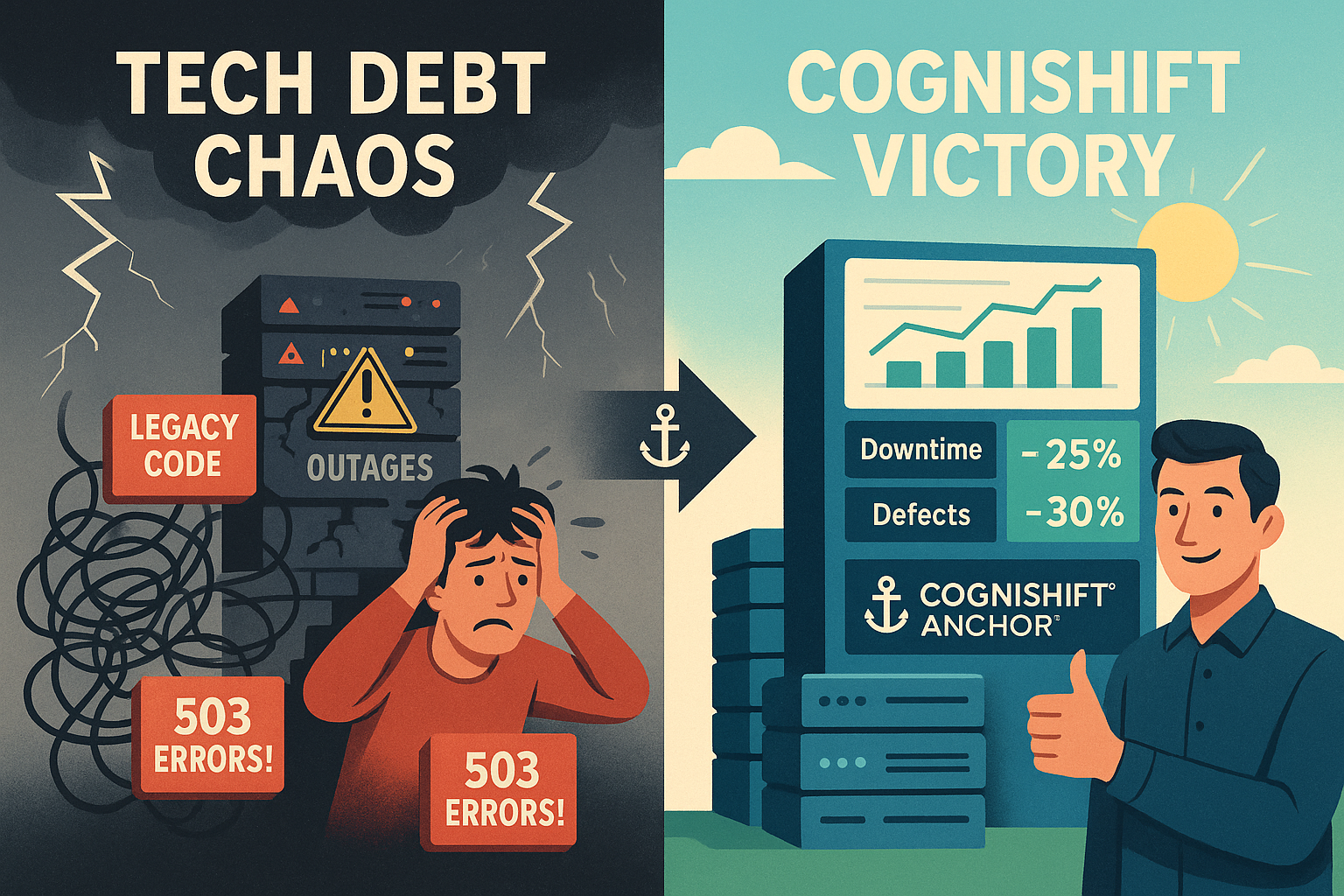
Your Tech Stack Is a Ticking Time Bomb
Your tech stack’s a ticking time bomb, packed with legacy systems and unresolved risks—code so ancient it’s practically fossilized, fragile servers, and the fallout from rushed projects are the explosives waiting to blow. You didn’t light the fuse, but it’s yours to defuse. This is technical debt, a snarl of shortcuts and aging systems bleeding your team dry while piling on interest: slower releases, bigger crashes, and compliance nightmares. Tech debt doesn’t pay itself—it’s a business killer, and the clock’s ticking.
Tech debt piles up through:
- Ancient Systems: Monoliths or outdated libraries like jQuery 1.x, choking on today’s scale.
- Management Missteps: Execs pushing “ship it now,” forcing devs to skip scalable designs or take shortcuts that haunt later, neglecting sustainability.
- Bad Bets: Flashy frameworks that flop under load, now a maintenance sinkhole.
- Vendor Traps: Microsoft or AWS slapping an “End of Life” notice on your database, risking breaches.
McKinsey’s 2023 numbers peg tech debt at 20-40% of IT budgets, choking innovation, tanking uptime, and making your legal team sweat GDPR fines.
Old Frameworks Fall Short
Teams try tackling tech debt with frameworks, but most are like fax machines in a cloud world—narrow and clunky. They focus on one piece—recording debt or sneaking fixes into sprints—while missing the full picture. Fowler’s Tech Debt Quadrant and Cunningham’s ROI Metaphor lack action plans; SQALE’s SonarQube ignores legacy systems; a Tech Debt Register can’t handle 50 services. These tools aren’t built for 2025’s chaos—think vendor lock-ins and Node.js 16’s EOL. You need a holistic approach.
Meet CogniShift Anchor™: Your Tech Debt Wrecking Ball
I built CogniShift Anchor™ – Tech Debt Management Framework to crush legacy debt, sloppy code, and EOL(End Of Life) traps while getting your C-suite to fund the cleanup—a full-spectrum plan to reclaim your stack. The diagram below illustrates CogniShift Anchor™’s five components, showing their iterative approach to managing tech debt.

CogniShift Anchor™ Framework for Tech Debt Management
CogniShift Anchor™’s Core Components
-
- Discovery and Assessment: Dig into past mistakes and future risks, mapping inherited debt like monolith designs and flagging EOLs. Tools like SonarQube and Endoflife.date uncover liabilities—a $100K breach risk from Apache Struts 2.3.x (EOL 2023)—ensuring compliance via a one-time audit and periodic reassessments.
- Prevention and Governance: Stop new debt with policies—enforcing lifecycle checks via dependency management, CI/CD guardrails, and dev training, alongside ADRs(Architecture Decision Record) to document and revisit design decisions for missed use cases or evolving needs. Enforced daily, it saved a migration nightmare by choosing Django 4.x over 2.x, fostering scalable designs.
- Prioritization and Planning: Build a roadmap to tackle high-risk systems, balancing factors like performance bottlenecks, security vulnerabilities, and business impact. Use ROI math (e.g., $20K risk from slow queries vs. $10K fix cost) to guide decisions. Update regularly to align with evolving priorities, ensuring quick wins and strategic upgrades.
- Stakeholder Engagement and Communication: Transform tech debt into a boardroom win by crafting compelling narratives and data-driven dashboards. For instance, a recent e-commerce client boosted customer retention by 10%—translating to $150K in annual revenue—after addressing slow page loads with a $30K investment, swaying execs to back the initiative. This builds a debt-aware culture and secures the funding needed for lasting impact.
- Execution and Monitoring: Integrate debt tasks into sprints—such as optimizing a critical API to slash downtime by 25% and boost user satisfaction—cutting defects by 30%. Dashboards track code quality, boosting release velocity and compliance. These results are fed back to stakeholders through regular updates, showcasing the value like reduced outages and improved performance, ensuring ongoing buy-in and alignment with business goals.
Why CogniShift Anchor™ Is Your MVP
CogniShift Anchor™ doesn’t mess around—no, not some half-baked Minimum Viable Product you’d slap together for a demo, but your Most Valuable Player that actually gets the job done. It fixes yesterday’s mistakes, guards tomorrow’s projects, and talks ROI in a language your execs understand, turning tech debt into a boardroom battle cry. Crucially, CogniShift Anchor™ can be customized based on the size, maturity, and behavioral aspects of any organization—large or small—since these three variables play a major role in successfully implementing any framework. At CogniShift, we’ve developed blueprints for ground-level implementation tailored to organizations of all sizes, from nimble startups to sprawling enterprises. This article previews the methodology, while the CogniShift Anchor™ – Tech Debt Management Framework Deep Dive provides the detailed implementation plans, techniques, actionable steps, and cadence for organizations of all sizes to ensure effective execution.
Take Control with CogniShift Anchor™
Tech debt doesn’t have to drain your budgets, slow your teams, or keep your compliance team up at night. At CogniShift, we designed CogniShift Anchor™ – Tech Debt Management Framework to empower organizations to tackle this challenge head-on. Start by adopting this framework to systematically address your tech debt with a clear, ROI-driven plan:
- Begin with Discovery: Map out the vulnerable parts of your stack and identify EOL risks that could lead to costly breaches.
- Establish Prevention: Set policies and guardrails to ensure new debt doesn’t creep in while you’re fixing the old.
- Prioritize Strategically: Create a roadmap that balances quick wins with long-term migrations, aligning with your business goals.
- Engage Stakeholders: Use data-driven dashboards and pitches to secure the budgets you need for sustainable change.
- Execute and Monitor: Integrate debt resolution into your sprints, track progress, and ensure compliance and performance improvements.
This isn’t just a fix—it’s a strategic shift to help your organization thrive. Reach me at sreeni@cognishift.ai, I can help you and make this work with your team.
