
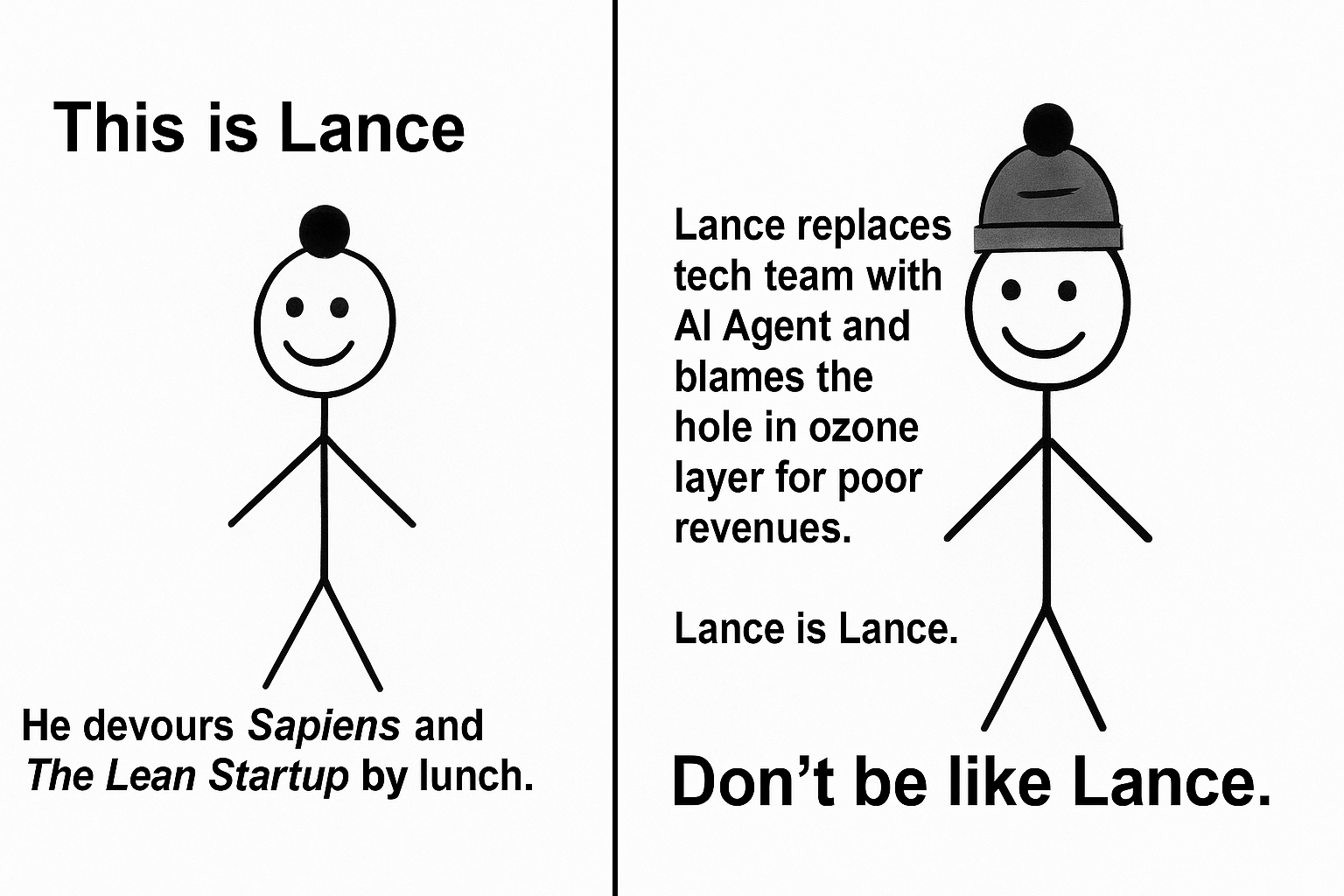
Every business faces a pivotal choice: adopt AI or stick to BAU (Business As Usual), shaped by its unique challenges. A 2025 McKinsey survey shows 78% of global companies are using or exploring AI in at least one function, aiming to boost investments, though 24% of those are more cautious, focusing on efficiencies like data automation rather than broader adoption. The impact varies. Chegg’s delay cost it 30% revenue and 31% subscribers in Q1 2025, triggering a 22% workforce cut, while Cisco thrives with AI in network management. The key is a tailored approach. Some pretenders, jumping onto the AI bandwagon like riding Kingda Ka after a heavy lunch, risk a messy tumble and offer us cautionary tales of how not to do AI.
Why Some Stumble, Others Soar
Across industries, AI missteps have sparked disasters – overpromised tools crashing, teams slashed without plans, and customers fleeing. These fumbles highlight the perils of unstrategic adoption, paving the way for deeper lessons. Chegg’s hesitation left it clinging to outdated EdTech, losing revenues and subscribers as free AI tools like ChatGPT outpaced its offerings. Cisco, however, soared by weaving AI into network management, boosting efficiency and outpacing rivals. Even well-intentioned AI plans can falter if poorly executed. Klarna initially replaced 700 customer service agents with AI to cut costs but faced a service quality drop. Showing courage, Klarna leadership pivoted, rehiring human agents to ensure customers could always speak with a person, blending AI efficiency with human touch. This adaptability underscores balancing innovation with customer needs. Misguided strategies, chasing trends without understanding needs, often lead to wasted resources, alienated clients, and failed projects that erode trust.
Lance’s Misadventure: Pretending to Be a Tech Giant
DreamyContent Inc, Lance’s firm – a custom content marketer, prints brochures, and hosts campaigns on creaky servers, with untapped tech potential. Lance, a self-styled tech titan, tried to mimic Fortune 50 giants. The big tech firms that produce AI tools cut their staff to prove and showcase efficiencies, but Lance had no justification. He dismantled most of his tech team, betting on an Autonomous AI Developer Agent to innovate. It backfired. The AI sent 10,000 blank emails to a client’s list, sparking a PR nightmare. No leadership, no gatekeepers, total chaos! Clients jumped to ChatGPT’s free tools, a hotel switched to Canva’s AI designs, and Mailchimp’s AI personalization outshone him. Lance’s revenue tanked, his remaining team’s morale evaporated, and competitors circled. AI was coming for his business, and he didn’t see that coming.
What bent instead? Focus. The U.S. shoveled $18 billion into Operation Warp Speed for vaccines; pharma chased the prize; tech CEOs showcased their dance moves on TikTok; Zoom became a global phenomenon; while quick apps ate the spotlight. No one grabbed the reins. The WHO didn’t pitch a global chain; there was no Hyperledger pivot; no one said, “This is it, let’s move.” Dashboards and tracing apps — fast, messy — took over. Blockchain’s chance slipped through the cracks.
How Not to Do AI: Lance’s Fallout
- AI Misstep: Lance’s grand “pivot” to AI? Pure genius, terminating his dev team to crown an Autonomous AI Developer Agent as overlord, because who needs humans with a digital deity?
- Churn Nightmare: Lance’s trial-billing-churn racket lured clients with freebies, but monthly charges lacked value in this AI-enabled DIY era. Buffer’s 38% churn in 2017 from price hikes mirrors his flop. Clients fled, loyalty shredded.
- Missed Opportunity: Toyota and Gillette disrupted internally with Prius and Mach3 before others could. Lance dodged AI’s wave, letting it drown him.
Carve Your AI Path: What Lance Should Have Done
Lance could have succeeded by riding AI hype, marketing DIY AI content, cashing in on AI flaws, ditching SaaS for pay-per-use, using AI to drive repeat business, thriving on predictable revenues (not MRRs… customers don’t like subscription shackles), and boosting valuation. Here’s the plan:
1. Launch a Freemium AI Content Platform
Add a free AI content feature (3 pieces/month) to their web platform via GPT-4o or Llama, Canva-smooth, no barriers. A Truth-O-Meter flags 48% hallucination alerts, offering fixes: $49 polish or $99 for 500 flyers. A CTO, dev shop, and $10,000/month for APIs/AWS could beta it in 3 months.
Why it works: Free access hooks clients, riding AI hype with DIY appeal.
2. Profit from AI Flaws with content experts
Three content experts fix AI’s hallucinations for $49-$199 per piece, with a 24-hour “Send to content experts” button. Host AI Mastery webinars to showcase fixes, offering sample revisions. Beta launch in a month.
Why it works: Cashing in on AI flaws builds repeat business while webinars amplify reach.
3. Scale with AI Print and Hosting
Use PrintIQ for $99 quotes, bundle AI ads plus 1,000 flyers for $199. Host on Vercel with AI analytics (e.g., 30% Gen Z hook, 15% ROI boost) for $49 publishing. Invest $10,000, integrate by month 5.
Why it works: AI analytics drives repeat engagement, boosting valuation.
4. Add High-Value Services
Hire 2 designers for AI visuals ($99-$399) and partner for AI-targeted campaigns ($149-$799). Add as $149 checkouts. Beta launch.
Why it works: High margins lock in clients, fueling predictable revenues.
5. Ditch SaaS for Predictable Revenue
Scrap trial-billing-churn spiral. Price a la carte ($49 edits, $99 prints) or bundles ($499 for 5 edits plus hosting). Target 8,000 clients at $300/month and month 9, you’re looking at $2.4M/month revenues. Train sales now.
Why it works: Pay-per-use stability supports growth and valuation.
The Moral of Lance’s Mess
The path to AI success isn’t chasing trends or copying others. It’s crafting a custom plan tailored to your business’s needs. To scale and future-proof, adopt AI with purpose: align with your goals, test rigorously, and deliver real customer value. A bespoke AI strategy ensures you ride the wave to growth, not wipeout.
